How to Get a CAD Model From a Part With No Drawings
No drawings for an old or discontinued part? Here's how reverse engineering and 3D scanning turn a physical part into an accurate, editable CAD model.
No OEM, no drawings, part still needs to run. Here's how to reverse engineer obsolete parts into production-ready CAD: process, tolerancing, material ID.
When the machine is still running but the OEM isn't, "just order the part" stops being an option. The company folded, the product line got discontinued, or the part was quietly redesigned three revisions back and nobody kept the old drawings. The equipment doesn't know any of that — it still needs a replacement bushing, bracket, impeller, or housing that fits and holds up. Reverse engineering is how you get from "we have the failed part in a bag" to a CAD model and drawing package a shop can actually quote and cut.
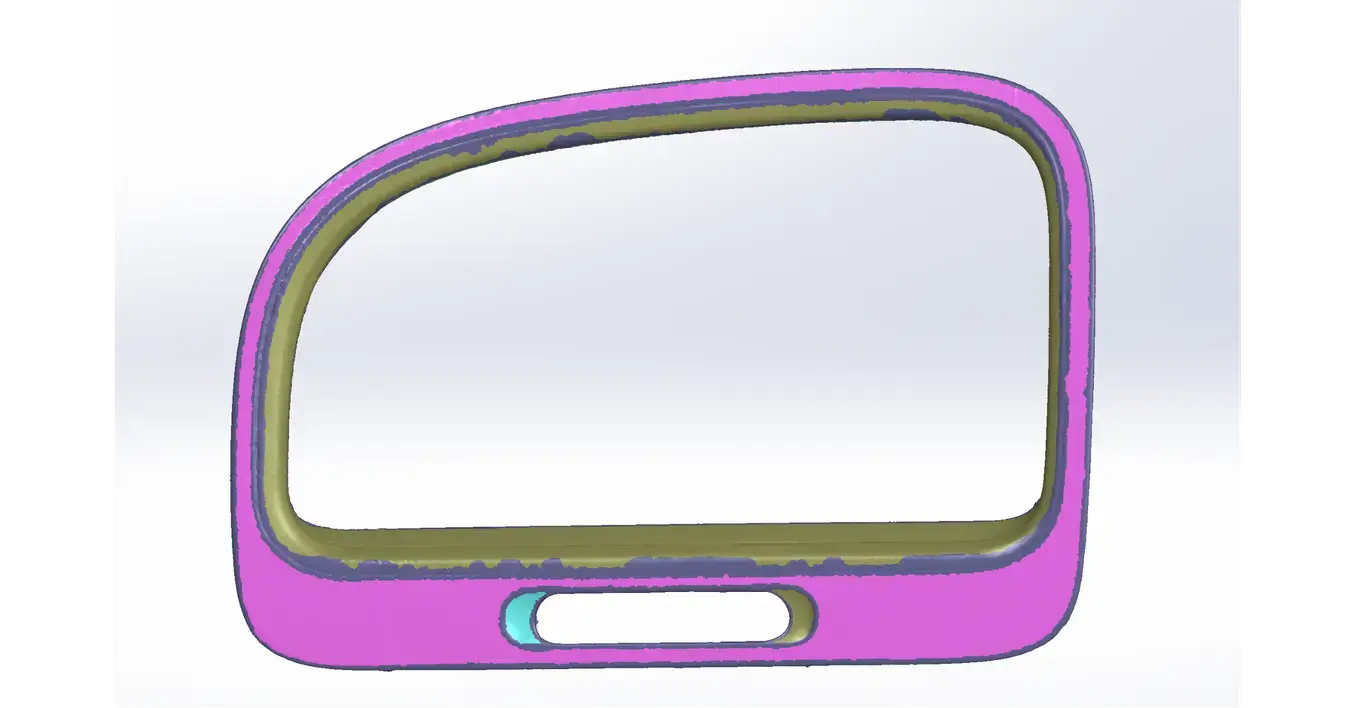
This is a different problem than reverse-engineering a part still in production somewhere, where a reference exists even if you can't get a copy. When the OEM is gone, there's no drawing to check your work against; everything gets re-derived from the physical part and how it functions in the assembly.
The obsolete-part problem shows up a few ways:
Before paying for reverse engineering, rule out the cheaper paths: new-old-stock at a distributor, a direct cross-reference to something still in production, or a sister facility with the drawing in a filing cabinet. Reverse engineering is for when those dead-end.
Turning a physical part into production-ready CAD with no reference drawing runs through a consistent sequence:
Skip step 3 or step 5 and the result is a model that matches the old part perfectly — including its wear, its damage, and any feature nobody can machine at a reasonable cost.
Two things make obsolete-part work harder than reverse-engineering a documented part.
The sample is often worn or failed, not pristine. A bushing bore that's run for eight years measures larger than the day it was made. The job isn't to copy the worn dimension — it's to work back to design intent using wear patterns, mating-part clearances, and a second sample where one exists, then reconstruct the nominal geometry and apply a tolerance that fits the application.
And there's no OEM material spec to check against. Without a cert or a stamped alloy code, identification typically narrows in stages: visual and magnetic sorting for the material family, hardness testing and portable alloy analysis to narrow it further, and a lab metallurgical test when the application justifies the cost. The result gets matched to the closest standard, available alloy — flagged if the original spec isn't obtainable either.
Not every reverse-engineered part should be a perfect copy. If the original design had a known weak point — a fillet that always cracked, a coating that never held up — reverse engineering is the moment to decide: replicate it exactly, form and fit and function, or keep the fit and function and improve the form. That decision belongs to whoever owns the equipment. If scope grows from "replicate this part" into "redesign this feature," that portion is standard product development work, typically quoted separately at standard design turnaround — as fast as 24 hours, typically 6-8 business days — instead of the reverse-engineering timeline.
Reverse-engineering work — scan through finished CAD — typically runs 8-10 business days. Short-range 3D scanning on its own starts at $260; a full reverse-engineering package (scan, CAD reconstruction, GD&T, drawing package) is scoped separately from that base scan price, since it depends on part complexity, tolerance criticality, and how deep the material ID needs to go. As a general range, that reconstruction work — CAD modeling from the scan through GD&T and the drawing package — runs $300-$800 per part for parts headed to 3D printing, and $800-$1,500 per part when the target is injection molding or CNC production.
The cost drivers aren't unique to any one shop: part size and geometric complexity, how many dimensions are functional versus cosmetic, whether material needs lab confirmation or just visual sorting, and how many mating parts also need measuring to nail the fit.
CADmore doesn't manufacture. It builds prototypes in-house to confirm the reconstructed design is right, but production runs go through the equipment owner's own manufacturer or CADmore's partner network. That separation matters here: a tolerance or material call is easy to quietly bend toward whatever one shop's equipment can hold when that same shop is also bidding to build the part. A design-only firm doesn't carry that conflict — the GD&T and material recommendation get set by what the application needs, then sent out to be quoted on their own merits.
If there's a failed part in a bag and no drawing to go with it, that's a normal starting point — tens of thousands of projects have been submitted through CADmore. Start a project with photos and dimensions of the part, book the $100 consultation to talk through scope first, or just reply with what's broken.
Yes — that's the normal starting point for obsolete-part work. The physical part gets 3D scanned to capture its geometry, then rebuilt as a parametric CAD model with dimensions and GD&T applied based on how the part functions in the assembly, not just what the scan measured. No OEM file is required.
Reverse-engineering your own equipment to make a replacement part for your own use is standard, well-established practice in maintenance and MRO. It gets more nuanced if the part is still protected by an active patent and still in production somewhere — that's a question for your own counsel, not a CAD question. Most obsolete-part work doesn't run into this, because by definition nobody's making the part anymore.
Through a narrowing process: visual and magnetic sorting for the material family, hardness testing and portable alloy analysis to narrow it further, and lab metallurgical testing for critical applications where the exact spec matters. The result gets matched to the closest available standard alloy or polymer.
Reverse-engineering work, from 3D scan through finished CAD, typically runs 8-10 business days. If the scope expands into redesigning a feature rather than replicating it, that portion is quoted at standard design turnaround: as fast as 24 hours, typically 6-8 business days.
No. CADmore is a design firm — it builds prototypes in-house to confirm the reconstructed CAD is right, but production runs go through the equipment owner's own manufacturer or CADmore's partner network. That keeps the tolerance and material calls independent of any one shop's production constraints.
No drawings for an old or discontinued part? Here's how reverse engineering and 3D scanning turn a physical part into an accurate, editable CAD model.
Discover the best practices in designing an injection mold to ensure high-quality, cost-effective, and timely production of plastic parts.
Uncover the advantages of a CADmore partnership in digital manufacturing. Read about success stories and effective partnership strategies.