Reverse Engineering Cost to CAD: A Pricing Breakdown
What drives the cost to reverse-engineer a part into CAD — geometry, tolerance, deliverable type — plus real industry price ranges and typical turnaround.
For a single part, reverse-engineering it into usable CAD commonly runs $300-$800 per part for a part headed to 3D printing, up to $800-$1,500 per part for a complex, organic-surfaced part headed to injection molding or CNC machining. The number moves almost entirely on three things: how complex the geometry is, how tight the tolerance needs to be, and what kind of CAD file comes out the other end. Here's what actually drives the price, with real ranges instead of one made-up figure.
What "reverse engineering to CAD" actually includes
Reverse engineering isn't one task — it's four, and skipping the last two is how you end up with a file you can't actually use.
Capture. The part gets measured, either by hand with calipers and a CMM for a handful of critical dimensions, or by 3D scanning for full-surface geometry. Short-range 3D scanning starts at $260 and is usually the fastest way to capture a part under a few feet across.
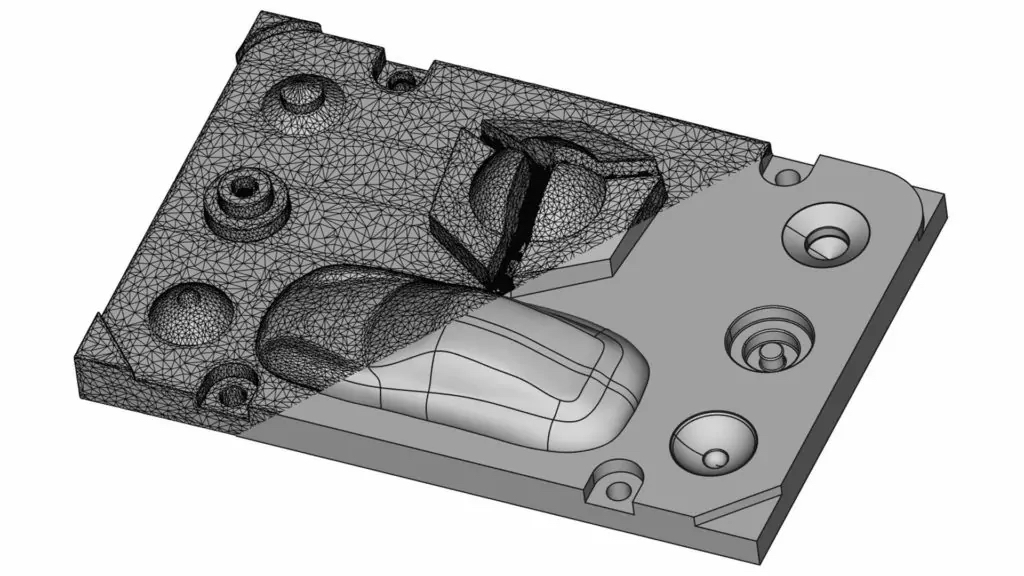
Cleanup and alignment. Raw scan data comes back as a mesh full of noise and overlapping passes that need to be stitched into one clean point cloud before anyone can model off it.
Reconstruction. This is where most of the labor — and cost — goes. A machined part with mostly flat faces, bores, and fillets rebuilds fast as a parametric, feature-tree solid model. A cast, molded, or sculpted part with freeform surfaces has to be surfaced patch by patch with NURBS geometry, which is slower, more manual, and the single biggest cost driver in reverse engineering.
Validation and delivery. The finished model gets checked against the scan data — a deviation map showing how far the CAD surface sits from the real part — then delivered as native CAD plus neutral formats like STEP or IGES, with drawings and GD&T if the part has to hold function, not just look right.
A quote for "just the scan" and a quote for "a machinable, toleranced model" are two different jobs. Know which one you're asking for before comparing prices.
What actually drives the price
Geometry type. Prismatic, machined geometry reconstructs quickly. Freeform or organic surfaces — housings, cast parts, turbine blades, anything sculpted — take multiples longer to surface accurately.
Size and access. A small part scans in one setup on a bench. A large part (tooling, fixtures, body panels) needs multiple scan positions stitched together, sometimes on-site at your facility, adding time on both ends.
Required accuracy. A rough model for visualization or reference is cheap. A model meant to feed a new mold, replace an obsolete part, or mate correctly with other components needs measured tolerances and validation against the physical part — a materially different deliverable.
Hidden geometry. Internal channels, wall thickness, or features under a cover can't be captured optically. That either means estimating from a cross-section of the part or CT scanning it — worth confirming up front whether that's even offered before you assume it's included.
Deliverable format. A raw mesh is the cheapest output. An editable, parametric feature-tree model that behaves like a normally-designed CAD file, not a frozen surface wrap, costs more because someone has to rebuild real design intent, not just trace a shape.
Part count. One bracket is one job. A housing with mating parts and fit tolerances is several reverse-engineering jobs plus an assembly check.
CADmore's price ranges for reverse engineering
Treat these as a starting orientation, not a quote:
Parts headed for 3D printing — prismatic geometry, mesh or basic solid model: $300-$800 per part
Parts headed for injection molding or CNC machining, or a complex/organic surface needing a fully toleranced model: $800-$1,500 per part
Multi-part assemblies price per part within those ranges.
What's fixed: short-range 3D scanning starts at $260, and reverse-engineering projects typically run 8-10 business days from part-in-hand to delivered CAD.
Why the file you get back matters as much as the price
CADmore doesn't run production, which shapes what "reverse engineering" means here. The deliverable — native CAD plus STEP/IGES — isn't built to make one particular shop's process look easy; it's built to be quoted out cold to your own manufacturer or to CADmore's partner network, with the tolerances the part actually needs rather than the ones that flatter a specific machine. If you need to confirm a reconstructed model actually fits and functions like the original before committing to a production run or a new mold, CADmore builds prototypes in-house to check that — a separate step from reverse engineering itself, but worth budgeting for on anything going into a new tool or an unfamiliar supplier relationship.
Getting an actual number
Ranges are a starting point, not a quote — two "brackets" can be five times apart in reverse-engineering cost depending on tolerance and surface type alone. Tens of thousands of projects have been submitted through CADmore, which is useful for one thing in particular: pattern-matching your part against similar ones fast, instead of guessing off a table like the one above. A $100 consultation gets an engineer looking at the actual part, photos, or drawing before anything is committed.
Send a photo, a sketch, or the part itself and get a real number back — start a project, book the $100 consultation, or just reply with what needs reverse-engineering.
Frequently asked questions
How much does it cost to reverse engineer a part into CAD?
Cost scales mainly with geometry complexity, required tolerance, and deliverable format — a raw mesh, a parametric feature-tree solid, or a fully toleranced GD&T model. At CADmore, reverse engineering commonly runs $300-$800 per part for a part headed to 3D printing, and $800-$1,500 per part for a part headed to injection molding or CNC machining; multi-part assemblies price per part within those ranges. Two parts that look similar can price very differently, so an exact number needs the actual part or drawing in hand.
What's the difference between 3D scanning and reverse engineering?
3D scanning captures the raw geometry of a physical object as a point cloud or mesh — that's data capture. Reverse engineering is the step after: turning that raw data into a validated, usable CAD model, either a parametric feature-tree solid or a clean surface model, with drawings if the part needs to hold tolerance. A scan alone gets you geometry; reverse engineering gets you something a machine shop or design team can build from.
How long does it take to reverse engineer a part into CAD?
Typically 8-10 business days from part-in-hand to delivered CAD. Larger parts, hidden internal geometry, or tight-tolerance requirements can push that longer.
Can a reverse-engineered CAD model be used to manufacture a replacement part?
Only if it's reconstructed to the right tolerance and validated against the original — a mesh traced into rough shapes isn't enough. It needs to be built as a properly toleranced, feature-based or fully-defined surface model, checked against the physical part with a deviation report, then delivered as native CAD plus STEP or IGES so any manufacturer can quote and machine it.
Do I need CT scanning to reverse engineer a part?
Only if the geometry you need is hidden from view — internal channels, wall thickness, features under a cover. Purely external geometry captures fine with standard 3D scanning; internal geometry needs either CT scanning or a destructive cross-section of the part. Confirm which capture method a shop actually offers before assuming hidden features are covered.
Discover how Cold Metal Fusion revolutionizes the production of complex closed vane impellers, enhancing efficiency, reliability, and...
John Carrington
Sep 30, 2025
Stay Ahead with CADmore Insights
Subscribe to CADmore's updates and be the first to access the tools and knowledge defining today's industry landscape. Stay informed, stay relevant, and stay ahead with CADmore.